Getting ahead of lung disease: Voyra Therapeutics targets pulmonary fibrosis

Rather than waiting until irreversible damage has occurred in progressive lung disease, Voyra Therapeutics is developing therapies designed to protect tissue and promote its natural regeneration. Now, with promising results in human IPF lung tissue and mouse models, the company is raising capital to move its approach closer to the clinic.
By Ruhani Chhabra
For patients diagnosed with idiopathic pulmonary fibrosis, a progressive disease that scars the lungs and makes breathing increasingly difficult, existing treatments can slow the decline — but they can’t stop or reverse it.
Rojo Ratsimandresy, CEO and co-founder of Voyra Therapeutics, believes part of the problem lies in the way our industry has traditionally looked for solutions.
“In traditional drug development, we tend to be conservative in the way we choose our target and modality to try to solve a disease,” Ratsimandresy says.
Voyra is taking a different approach. Rather than targeting individual drivers of disease after significant damage has already occurred, the Bakar Bio Labs tenant company is developing IPF therapies aimed at intervening earlier — in areas of the lung where the progenitor cells are still present and functional.
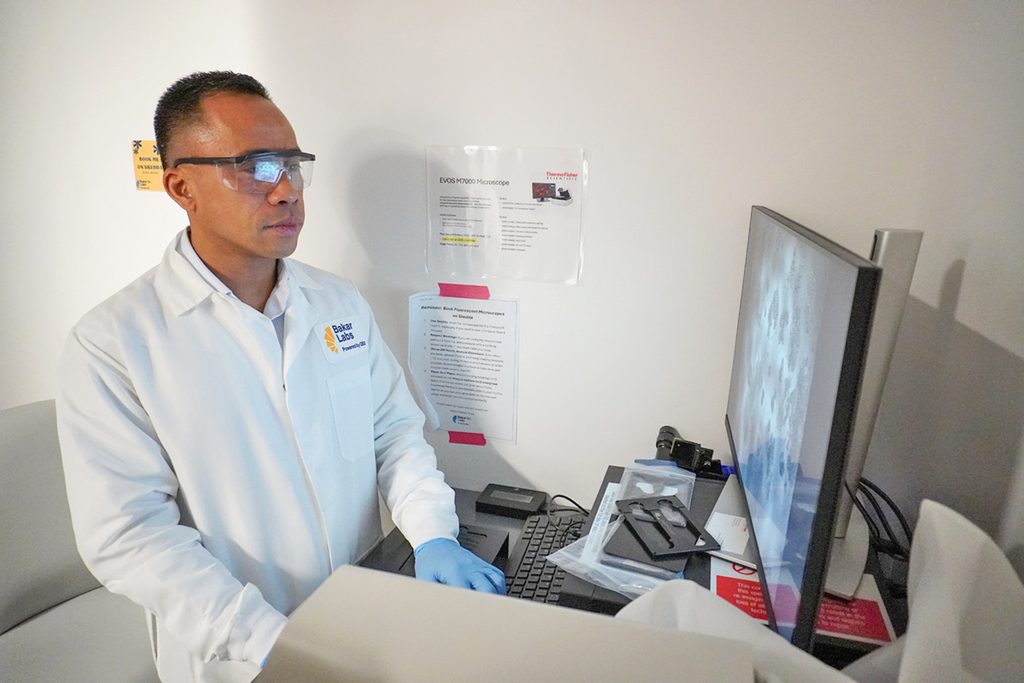
“We’re not trying to play a game of whack-a-mole and block one or two different disease drivers,” Ratsimandresy says. “We’re trying to protect the tissue against present and future micro-injuries and promote its natural regeneration.” These micro-injuries are idiopathic but in cases where the causes are known, they are usually due to silica induced pulmonary fibrosis.
The idea behind Voyra grew out of Ratsimandresy’s own path from academic research to drug development. After completing his Ph.D. in Paris studying inflammatory diseases, scaling a peptide-focused biotech out of his bench science, he moved to the U.S. for a postdoctoral fellowship at Northwestern University before eventually joining Genentech.
At Genentech, Ratsimandresy began working in lung disease, leading the biology of a program exploring a potential treatment for pulmonary fibrosis and inflammatory bowel disease. Over three years, he saw the program progress from early research to multiple Phase 2 clinical trials, giving him firsthand experience at moving an idea from the lab toward patients.
After later working at Xaira Therapeutics, Ratsimandresy decided to pursue his own idea. In September 2025, he co-founded Voyra Therapeutics, building the company around promising biological targets that have largely remained outside the industry’s comfort zone. The company is now raising capital to support its next stage of development.
“We are going after targets that are well-supported mechanistically, but that industry finds too risky — for now,” Ratsimandresy says.
Voyra is structured as a drug development company rather than a drug discovery company, allowing the team to focus on advancing and optimizing its therapeutic candidates rather than spending years searching for new targets. Voyra’s approach combines advanced computational peptide design, domain expertise in indications of interest and a human data-centric approach to drug development.
That strategy is already yielding results. Voyra recently tested its approach in human IPF lung tissue — an important early step in determining whether its hypothesis can translate beyond laboratory models — and saw promising results. Voyra recently filed for composition-of-matter protection on a novel family of long-acting peptides.
“We can now fundraise on an idea that is already supported by our own data both from human tissues and mouse models,’” he says.
For a young, bootstrapped company, moving that quickly also depends on having access to the right infrastructure. Voyra officially joined Bakar Labs in April 2026. Ratsimandresy says access to Bakar Bio Labs’ shared instrumentation has allowed the team to use equipment that would otherwise be difficult for an early-stage company to afford.
In fact, some of the most valuable resources have come from the other scientists working alongside them. After Ratsimandresy spent months troubleshooting an experiment, he turned to Bakar Bio Labs’ CEO Slack channel for help. Another tenant connected him with someone using the same testing method, who helped identify a surprisingly simple issue. Soon, Voyra was able to move forward with its experiments.
“That’s the other aspect I love about Bakar Bio Labs,” Ratsimandresy says. “There are so many different companies at a similar stage as us. We’re actually very helpful to each other that way.”
Now, Voyra is looking toward its next stage of growth. Ratsimandresy envisions the company advancing into clinical trials within the next three years, with the ultimate goal of testing whether intervening earlier in disease can do more than slow patients’ decline.